Showing posts with label Hien Thi Tran. Show all posts

Monday, February 22, 2016

Are you safe in your vehicle? Is NHTSA adequately protecting you?


Owners of several vehicles on the lists that have been made available have been defensive "Not my car!' 

Think again!

Evidence indicates that TAKATA KNEW!
Evidence indicates that NHTSA failed to act expeditiously.


Air Bags intended to protect drivers and passengers have become KILLERS to some, showering the driver with shrapnel. 


Air Force Lt. Stephanie Erdman: 
"My passenger only had mild scrapes and bruises," she told lawmakers. "I should not have been injured in the shocking and terrifying way that I was."
A jagged piece of metal shot through Erdman's airbag and imbedded itself in her right eye, while also fracturing her right nasal bone. At the hearing Thursday she displayed a graphic photograph of herself with a chunk of metal protruding from her right eye.
"I was instantly blinded on my right side," she said. "I felt blood gushing down my neck. I was terrified. My vision will never be the same. I will never be the same."


Florida resident Stephanie Erdman suffered severe injuries in September 2013 when a Takata airbag exploded in her Honda Civic, sending metal fragments flying at her face.

http://www.citizensreport.org/2015/11/03/takata-airbag-recall-expanded/


When police got to the scene of a minor car accident in Alhambra, California in September 2013, they thought the driver, Hai Ming Xu, had been shot in the face.

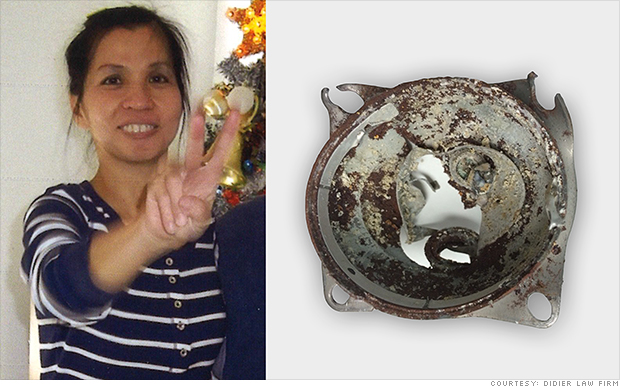
A similar conclusion was reached by Orlando police responding to an accident a year later -- they believed that the driver, Hien Thi Tran, had been the victim of a stabbing that might have caused the accident.
[Hien Thi Tran]....an autopsy released this week found that the cause of death were the metal and plastic fragments that cut her neck.


In most cases the airbags deployed during a minor accident. But one lawsuit charges that the airbags in a 2001 Honda Civic deployed for no apparent reason while the car was stopped at a red light.
The driver in that case, Kristy Williams, barely survived the 2010 accident. Shrapnel tore into her carotid artery. She was able to insert two fingers into the wound to stop the bleeding, and a nearby pedestrian put pressure on the neck wound until help arrived. But she still had several strokes and now suffers from traumatic brain injury, according to her suit.

Takata airbag victims looked like they had been shot or stabbed

http://money.cnn.com/2014/11/20/autos/takata-airbag-victims/


U.S. investigating all Takata air bags 
with troubled propellant


Takata


Wednesday, February 18, 2015

Recalls reach unwanted record - NHTSA's Failure to Protect YOU!


This family was killed in a RUNAWAY LEXUS:


TOYOTA settled for $10 MILLION with a CONFIDENTIALITY AGREEMENT.


TOYOTA settled this SUDDEN UNINTENDED ACCELERATION case with a CONFIDENTIALITY AGREEMENT....you'll never know what the price of silence is worth to TOYOTA....


Koua Fong Lee was imprisoned because his RUNAWAY TOYOTA killed:


His story is here:


Claribel Nunez was injured by TAKATA AIRBAG SHRAPNEL:


Air Bag Lawsuits: S. Florida Woman Sues Takata Over Exploding Fragment That Injured Her Head


Hien Thi Tran was killed by TAKATA AIRBAG SHRAPNEL:


Takata airbag victims looked like they had been shot or stabbed


TRAFFIC SAFETY

Recalls reach unwanted record

Total of nearly 64 million vehicles exceeds three preceding years' total
 
 
One of the biggest recalls of 2014 was over faulty ignition switches used by General Motors in a range of cars for more than a decade. Molly Riley/Associated Press file


By Christopher Jensen
The New York Times
Posted Feb. 17, 2015 @ 2:01 am


The auto industry recalled almost 64 million vehicles for safety problems last year, a record, according to figures released Thursday by the National Highway Traffic Safety Administration.
The number of recalled vehicles exceeded the total for the previous three years combined.
The agency and automakers faced intense scrutiny in 2014 and sometimes scorching criticism from Congress about whether safety defects were being investigated properly and vehicles recalled promptly.
Of the 803 vehicle recalls, 123 resulted from NHTSA investigations or contacts with automakers. The other 680 were initiated by the automakers after they discovered a problem and, as the law requires, reported it.
While the recalls last year covered a wide range of defects, two problems were most prominent, affecting millions of vehicles: faulty ignitions in General Motors cars, and flaws in Takata air bags that could send shards of metal into the passenger compartment.
An investigation last year by The New York Times of the NHTSA found that the agency had frequently been slow to identify problems, tentative to act and reluctant to employ its full legal powers against companies.
In a statement Thursday, Mark R. Rosekind, who was confirmed in December as the agency’s administrator, said, “These figures demonstrate the need for vigorous, effective oversight to remove safety defects from our highways.”
The agency said the 123 recalls it prompted resulted in the recall of 19.1 million vehicles. That was, the agency said, “the highest number of vehicles recalled due to NHTSA investigations and enforcement efforts” since 1981. But that was also the smallest number of recalls resulting from agency action since 2010. In 2013 the agency influenced 166 recalls, but that resulted in the recall of only 7.1 million vehicles because the problems affected fewer models.
The number of vehicles affected by a single recall can vary widely.
In a departure from its practice in previous years, NHTSA did not release the number of recalls by manufacturer. But General Motors accounted for almost 27 million of the recalled vehicles, the automaker said.
According to the automakers, Honda recalled about 8.9 million vehicles last year, Fiat Chrysler recalled about 8.8 million, Toyota recalled about 6 million and Ford recalled almost 4.9 million.
Automakers recalled almost 22 million vehicles in 2013 and about 16 million a year in 2011 and 2012.
The agency also said that almost 7.7 million seats designed to restrain children in an accident were recalled in 2014, the second-highest number since it began recording such actions in 1972.
Almost all of those child restraint seats were recalled as a result of pressure from the federal regulators on Graco Children’s Products, which recalled about 6.1 million seats, and Evenflo Co., which recalled 1.6 million. The seats had the same problem, a bulky buckle that federal regulators worried could trap a child in a seat.


This highlights the failures of the Automotive Industry and NHTSA [dubbed: No Help To Solve Anything by Parris Boyd].

NHTSA has become little more than a revolving door for industry, lacks the expertise to examine many of the defects and has ignored complaints filed by vehicle owners.

NHTSA is grossly underfunded for the tasks with which it is charged, lacking the manpower and expertise.

While this isn't political, the GOP have vowed to shrink government to drown it in a bathtub. That means you are NOT protected!

The National Car Wash Association knows which vehicles experience SUDDEN UNINTENDED ACCELERATION. Consumers don't!

http://jessiepowell.blogspot.com/search/label/National%20Car%20Wash%20Association

Exploding Takata AIRBAGS kill! Where was NHTSA?

AIRBAGS fail to discharge in an accident or discharge while driving.
Where is NHTSA? 


The Auto Industry can't get your vehicle to function uneventfully and they're gonna give you a driverless vehicle?

Do you trust them?

The lackeys in Congress has mostly remained silent with the exception of a few.

Please support those who have supported protecting consumers and spoken out against well-funded lobbyists.  


JUST MY OPINION .... AT THE MOMENT!

Monday, December 1, 2014

'Toyota Corolla crash' victim was stabbed: police


AIRBAG STAB WOUNDS ???

EXPLODING TAKATA  AIRBAGS have created a sad challenge for law enforcement.


Hien Thi Tran:


Takata airbag victims looked like they had been shot or stabbed


November 20, 2014

When police got to the scene of a minor car accident in Alhambra, California in September 2013, they thought the driver, Hai Ming Xu, had been shot in the face.


A similar conclusion was reached by Orlando police responding to an accident a year later -- they believed that the driver, Hien Thi Tran, had been the victim of a stabbing that might have caused the accident.

Court records and police reports show two other fatalities tied to the exploding airbags, which were also both in Honda (HMC) cars:
  • Ashley Parkham, killed in a 2009 accident in Midwest City, Oklahoma.
  • Gurjit Rathore, killed in Richmond, Virginia on Christmas Eve, 2009.


http://money.cnn.com/2014/11/20/autos/takata-airbag-victims/


'Car crash' victim was stabbed: police                               

TALIA SHADWELL
 
Last updated 15:44, November 30 2014
 
VICTIM: Matthew Stevens was found lying by his car.
Supplied
VICTIM: Matthew Stevens was found lying by his car.


Police say a man found lying dead by his car on the Kapiti coast had been stabbed.

Detectives carrying out a homicide investigation into 32-year-old Matthew Stevens' death are now carrying out a search warrant at a Hutt Valley house they have confirmed is a focus of their inquiries.

Police said this afternoon that Stevens, who was found lying dead by his car off the Paekakariki Hill Rd on the Kapiti Coast, had been stabbed about the torso. They are now tracing Stevens' final movements as they hunt for whoever is responsible for his death along with the missing weapon - thought to be a knife.

Stevens was at first thought to have died in a car crash on Thursday or Friday.

Police said an autopsy completed Saturday night confirmed the 32-year-old Hutt Valley man had suffered stab wounds.

The investigation was upgraded today.

Police are currently at an Epuni home where laboratory tents have been erected and a detective confirmed to Fairfax Media their presence there is for a search warrant linked to the homicide investigation.

Detective Sergeant Mike Sears said Stevens had sustained "a number of abrasions" but the stab wounds around his torso were the cause of his death.

"The post mortem confirmed that he had been the victim of an assault and a sustained... number of stab wounds has led to his death."

Police had not yet established where the stabbing took place, Sears said.
                                  
"We haven't ruled out whether the assault occurred in his vehicle or at another address."

They were still working to establish whether Stevens had driven is car to the spot he was found dead or whether someone else drove, Sears said.

The police have not found the weapon but believed it was a knife, Sears said.

Police had not established any signs of trouble leading up to Stevens' death so far, Sears he added:

"No signs of anything untoward - so, again, that's a focus of our investigation."

Investigators were trying to trace Stevens' last movements from when he left his home at 10pm on Thursday night to early Friday morning and are seeking sightings of his car in the Hutt Valley and Greater Wellington areas.

Sears said investigators were looking to seize 24 hour surveillance cameras belonging to businesses and Paekakariki Hill Rd area residents that might have captured Stevens' final movements.

Sears said police wanted to hear from anyone who saw Stevens or his vehicle, a white Toyota Corolla with the registration RZ1852, any time from 10pm on Thursday through to 1.30am on Friday 28 November.

http://www.stuff.co.nz/national/crime/63687996/Kapiti-car-crash-ugraded-to-homicide


Sunday, November 30, 2014

Inside Takata, tantrums, but little sense of crisis over air bags


SEE:

Akiko Takada, CEO's mother, reported to be dominant person in Takata


Stephanie Erdman was injured by an EXPLODING TAKADA AIRBAG:


Hien Thi Tran was killed by an EXPLODING TAKADA AIRBAG:


Inside Takata, tantrums, but little sense of crisis over air bags


By Norihiko Shirouzu

TOKYO, Nov 30 (Reuters) - Shigehisa Takada, the third-generation head of Takata Corp, shows little sense of the crisis engulfing the Japanese air bag maker at the centre of one of the auto industry's biggest safety recalls, according to three people who have met him recently.

Just days before a Nov. 21 U.S. congressional hearing on defective Takata air bags that have been linked to at least five deaths, Takada told business associates he was personally dealing with the quality issues, and his company had identified and fixed the main cause of the defect - which he said was mainly a flawed manufacturing process, the people said.

He told them that Takata had significantly improved its air bag propellant chemistry for bags it is using to replace defective ones, and the company now just has to step up and replace all suspect air bags as quickly as possible.

"He acts like this recall is going to blow by in due time and harbours little sense of crisis," said one of the associates, none of whom wanted to be named given the sensitive nature of their comments.

More than 16 million vehicles have been recalled worldwide since 2008 over Takata's air bag inflators, which can explode with too much force and spray metal fragments into the car.


LOW PROFILE

Takata's handling of the massive safety recall has frustrated U.S. politicians and regulators and has confused drivers as to whether their cars need fixing or not.

Takada, the Tokyo-based company's 48-year-old chairman and CEO, apologised at the annual shareholders' meeting in late-June, which was closed to the media, but has otherwise not been seen in public.

"He's a nice man, very sincere and seemingly capable, but he doesn't view this as a crisis spiralling out of control," said another of the business associates.

The scale of the recalls looks certain to escalate after U.S. safety regulators ordered Takata last Wednesday to expand piecemeal regional recalls of driver-side air bags to cover the entire United States, not just hot and humid areas where the inflators are thought to become more volatile.

Takada did not explain to the business associates exactly what Takata had done to improve the propellant chemistry and manufacturing process, and they said he should be explaining these changes publicly.

They said his reluctance or inability to do so may in part be due to the influence his 74-year-old mother retains at Takata, which was founded by his grandfather more than 80 years ago as a textile mill.

Shigehisa joined the family firm straight from university, became president in 2007, aged 41, and moved to the top executive post after the death in 2011 of his father, Juichiro, who built Takata into Japan's leading auto safety manufacturer.

Juichiro, known in the U.S. as "Jim Takada", was a rolled-up sleeves executive who donned a hard hat on site visits and once was spotted down on his hands and knees checking a faulty machine in a noisy textile plant in South Carolina, recalled a former colleague of the current CEO.

His son, he added, is very different - "painfully shy, bookish and into computers ... very good with statistics."

"BIG WIFE"

His mother Akiko, a former Takata executive, now heads the non-profit Takata Foundation, but remains vocal as a special adviser to the company. Some managers call her "O-okusan", or "big wife", underscoring her influence, while Shigehisa is referred to as "the son", or "Shige-chan" - a familiar, short form of his name with a suffix normally reserved for children.

"In a business situation, she could be very forceful and tries to impose her way in just about every way possible," said one of Shigehisa's business associates who has worked with Akiko on a project. Two of the three associates recalled how she once engaged in a tit-for-tat negative campaign with a rival.

"Imagine being her son and trying to exercise leadership with her buzzing around you," the person said. "He's paralyzed to make decisions on his own."

Takada is also under pressure from big automaker clients such as Honda Motor and Toyota Motor which try to control and influence how Takata deals with the recalls, two of the business associates said. Also, external legal advisers hired in the United States have focused on minimizing potential court damage rather than on repairing a battered public image.

The business associates said the lawyers restrict what Takada and other executives say and do publicly.

"Takata management's ability is not hindered by any forces from within the company or from outside," spokesman Toyohiro Hishikawa said in response to Reuters queries for this article.

In response to criticism that Takata's leadership has not been more visible, Hishikawa said: "That doesn't rule out the possibility of our top management team explaining our stance on and response to the recalls more publicly in the future."

Takata, which has around 43,000 employees globally, has seen its market value slump almost 60 percent this year to just above $900 million.

In one recent incident, Shigehisa went "missing for a few hours" from Takata's Tokyo headquarters after a row with his mother, said one person familiar with the matter.

"He was yelled at by his mother and went missing. Nobody knows where he went.

He came back after a few hours," the person said. (Additional reporting by Paul Lienert in Detroit and Antoni Slodkowski in Tokyo; Editing by Ian Geoghegan)


Read more: http://www.dailymail.co.uk/wires/reuters/article-2854791/Inside-Takata-tantrums-little-sense-crisis-air-bags.html#ixzz3KYbr0WeB
Follow us: @MailOnline on Twitter | DailyMail on Facebook


Wednesday, November 26, 2014

Corey Burdick blinded by EXPLODING TAKATA AIR BAG


Eustis man claims faulty air bag blinded him


NHSTA: Air bags in about 7.8 million vehicles could have defects
The morning of May 29, Corey Burdick was driving to work in his 2001 Honda Civic like he would any other day.

The 26-year-old Eustis father of two boys was heading to his job as a forklift operator.

As he turned from Haselton Street to Orange Avenue, going 15 mph, Burdick collided with another car. And his air bag deployed.

In the brief moment it took for the bag to fill with nitrogen gas, a scrap of metal flew out of the igniter that set the bag in motion, said his lawyer, Richard Newsome.

The metal shard hit the coffee cup Burdick was holding and ricocheted into his right eye, Newsome said.

With stitches from his eyebrow to his nostril, Burdick was left blind in one eye, Newsome said. But the impact of the crash itself did not badly injure him or the other driver.


Burdick filed a lawsuit in July against Honda and Takata, the Tokyo-based company that manufactured the air bag.

"He's going through a lot right now, and he's still trying to sort out what it means for him and his family," said Newsome, who declined to make Burdick available for an interview Thursday.

Burdick's case is one of at least three possible Takata air bag malfunctions that has caused serious injury or death in Central Florida since 2009.

Air bags in about 7.8 million vehicles could have similar defects, according to the National Highway Traffic Safety Administration.

Owners of cars covered by the recall should replace their air bags immediately, the agency said in a statement. Recalls began in 2008, according to Honda, and have been expanded since.

"Responding to these recalls, whether old or new, is essential to personal safety and it will help aid our ongoing investigation into Takata air bags," NHTSA Deputy Administrator David Friedman said in a statement.

The air bag recall which was expanded earlier this week includes cars made by BMW, Chrysler, Ford, General Motors, Honda, Mazda, Mitsubishi, Nissan, Subaru, and Toyota, and model years from 2000 to 2011, according to NHTSA.

A Honda spokesman said the company sent a recall notice to Burdick's father-in-law, the Civic's registered owner, before the crash.

"Honda is always concerned when one of its customers is injured and Honda is actively working with Mr. Burdick and his counsel in an effort to resolve his claim," spokesman Chris Martin said.

Takata could not be reached for comment Thursday.
Air bags made by Takata, the Tokyo car parts manufacturer, have been involved in about 10 crashes nationwide that ended in serious injury or death, said Sean Kane, founder and president of Safety Research & Strategies, a Massachusetts-based consulting company.

"One of the problems that we're seeing with this is that the recall spans such a long time," Kane said.

"The one theme that we continue to see through these recalls is the quality control problems remain unresolved at the Takata plant."

The problems are likely caused by an igniter in the air bag, Kane said.

When a vehicle's sensors detect a crash, a chemical compound, sodium azide, is heated up until it decomposes, producing enough nitrogen gas to fill the bag. But if an igniter is over-pressurized or not welded correctly, it can explode, sending metal fragments through the air bag and toward the driver, Kane said.

Igniters regularly exposed to high temperatures can degrade more quickly, Kane said. NHTSA said vehicles in states with hot and humid climates, including Florida, could be at greater risk.

Most recently in Central Florida, 51-year-old Hien Tran was fatally injured driving home from her family's nail salon south of downtown Orlando the night of Sept. 29 when her 2001 Honda Accord collided with another car. Nearby drivers and emergency personnel who tried to save her found deep gashes on the side of Tran's neck – cuts that investigators initially thought might have come from an attacker's knife.

Orange County Sheriff's Office detectives later discovered that the injuries were likely caused by metal fragments which flew out of Tran's air bag. Tran died Oct. 2.

Jennifer Griffin of Orlando was sad to hear of Tran's case because it sounded similar to her own injury.

In 2009, Griffin was driving a silver 2001 Honda Civic to a nearby Publix when another driver turned and struck her car, she said in an interview Thursday.

Griffin's air bag deployed.

"And honestly, I don't remember anything. I guess I blacked out, and woke up with somebody knocking on my window or door asking if I was OK," she said.

A piece of her Takata air bag's igniter flew through the bag and sliced an artery on the left side of her neck, she said. Another piece hit her in the chest.

She had to wear a brace for five months, and still has scars, she said.

Griffin hired lawyers, who told her that a small air bag recall issued before her crash included other Hondas, but not her 2001 model.

She settled out of court with Honda. The terms of the settlement were not disclosed.

Griffin said she was upset by Tran's death. Takata and the car companies, she said, should have acted more quickly after the first air bag recall in 2008.

"They knew about it, they've known about it for a long time. They're still just doing small amounts of recalls," she said. "…Nobody should have died after that, or gotten hurt after that."

Honda bought Griffin's totaled Civic from her to use for testing, she said. She drives a Buick now.

To check whether a vehicle is included in a recall, look up its Vehicle Identification Number and call the Auto Safety Hotline at 1-888-327-4236 or go to safercar.gov


http://www.orlandosentinel.com/news/breaking-news/os-honda-airbag-lawsuit-corey-burdick-20141023-story.html

Japanese Secrecy & Cover-Up: REFUSE to IDENTIFY MAKE WITH EXPLODING TAKATA AIRBAG!


Your life is at risk, the lives of your passengers and family are at risk because of the AUTO INDUSTRY FAILURES and COVER-UPS!


Stephanie Erdman.....


WASHINGTON, DC – NOVEMBER 20: Committee Chairman Sen. Bill Nelson (D-FL) (R) holds up a photo of Stephanie Erdman of Destin, Florida, of her face injury by the airbag explosion in her Honda Civic after a traffic accident last year, as Sen. Amy Klobuchar (D-MN) (L) looks on during a hearing before the Senate Commerce, Science and Transportation Committee November 20, 2014 on Capitol Hill in Washington, DC. The committee held a hearing to examine defects in airbags manufactured by Takata and their recall process. (Photo by Alex Wong/Getty Images)
FROM: Senators Get No Clear Answers On Air Bag Safety

...Schostek acknowledged that Honda violated federal requirements to report deaths, injuries and safety defects to the National Highway Traffic Safety Administration.


Another Phony Baloney Japanese “deeply sorry and anguished”   after another Japanese COVER-UP....


.....Hiroshi Shimizu, Takata’s head of quality, said the Japanese parts supplier is “deeply sorry and anguished” about each instance of air bag inflators not performing as designed.

....senators were stymied by what they considered evasive answers from Takata, Honda and Chrysler executives. And they suggested a cover-up by Takata, which reportedly conducted secret tests of the air bags in 2004.

Sen. Claire McCaskill, D-Mo., whose Commerce subcommittee investigated the General Motors ignition-switch debacle, saw echoes of that in the air bag problem now under scrutiny.

She noted “an industry that fears no consequences from not complying with the law” and a federal regulator lacking the resources and expertise “to properly do its job.”

...Shimizu said he was first told in 2005 about the problems, but said Takata did not inform NHTSA at that time. Takata conducted an investigation of the defects in 2007, he testified.


Hien Thi Tran lost her life because of an EXPLODING TAKATA AIRBAG...


Takata Air-Bag Rupture in Japan Test Signals More Recalls

Thursday, November 13, 2014

GLOBAL EPIDEMIC: When the TAIL WAGS THE DOG!


NHTSA is in bed with the Auto Industry.....and has failed to protect consumers!


People are being killed because of NHTSA's failures!


Woman in Malaysia Takata Air-Bag Crash Was Pregnant