Welcome to the Official Informational Website for the Takata Settlement
This is the informational website for the proposed economic loss class action settlements with BMW, Honda, Mazda, Nissan, Subaru, and Toyota in a class action lawsuit styledIn Re: Takata Airbag Products Liability Litigation, Master Case No. 1:15-MD-02599-FAM. The Court preliminarily approved the settlements with BMW, Mazda, Subaru, and Toyota on June 9, 2017 and issued preliminary approval orders that were docketed on June 12, 2017. The Court preliminarily approved the settlements with Honda and Nissan on September 19, 2017.
For more information, please select the appropriate Settlement below referencing the automobile manufacturer of your Subject Vehicle.
Important Note: Some vehicles included in the Settlement will be recalled at a later date and others may not require a recall. Your receipt of a Settlement Notice does not mean your vehicle is subject to a recall. Please refer to the National Highway Traffic Safety Administration’s website, www.safercar.gov, for the latest information about Takata recalls and to determine if your vehicle is subject to a recall.
Takata agrees to $650-million settlement over air bags but will pay only a fraction of it
ASSOCIATED PRESS
(Los Angeles Times)
Japanese air bag maker Takata Corp. has reached a $650-million deal to settle consumer protection claims from 44 states and Washington, D.C., but only a fraction of the money will be paid because of Takata's financial problems and bankruptcy.
In an agreement announced Thursday, the states said they will not collect the settlement so victims of Takata's faulty air bag inflators can get a bigger piece of the company's remaining money. The exception: South Carolina, which led the states, will get just over $139,000 to cover costs of the investigation.
Takata air bag inflators can explode with too much force and spew shrapnel into drivers and passengers. At least 22 people have died worldwide, and more than 180 have been hurt.
Attorneys general for the states alleged that Takata concealed air bag issues and failed to disclose safety defects.
Takata was forced into bankruptcy last year amid lawsuits, multimillion-dollar fines and crushing recall costs involving air bag inflators that use the explosive chemical ammonium nitrate as a propellant. The chemical can deteriorate over time when exposed to high heat and humidity and then burn too fast, blowing apart a metal canister.
A reorganization plan was approved last week by a federal bankruptcy judge in Delaware.
Under Thursday's deal, Takata agreed not to represent its air bags as safe unless supported by scientific evidence, not to falsify any testing data and to keep cooperating with automakers to make sure replacement inflators are available. It also agreed not to sell any air bags that use ammonium nitrate unless it's for recall replacement parts. Some of the provisions already were included in an agreement with the National Highway Traffic Safety Administration.
A Takata spokesman did not respond to requests for comment Thursday.
As part of a criminal plea agreement with the U.S. Justice Department, Takata agreed to pay victims $125 million and to pay $850 million in restitution to automakers that bought its inflators and are stuck with recall and litigation costs. Under the restructuring plan, Takata will sell most of its non-air bag assets to a Chinese-owned rival for $1.6 billion.
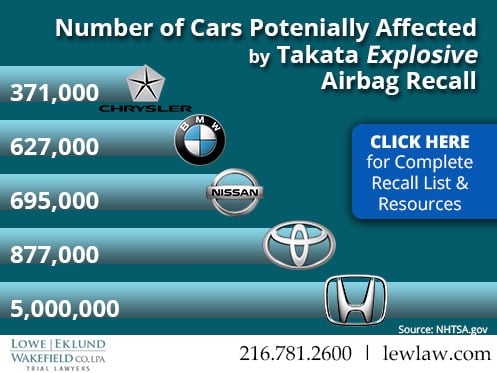
The inflator problem touched off the largest automotive recall in U.S. history. As many as 69 million inflators in the U.S. and an additional 60 million worldwide are being recalled, according to court documents and the National Highway Traffic Safety Administration.
PLEASE! If your vehicle has an EXPLOSIVE TAKATA AIRBAG, PLEASE! For your protection, get this corrected!
Toyota expands Takata airbag recall by 600,000 units
January 9, 2018
by Drew Johnson
Toyota's Takata airbag recall just got bigger.
Toyota has expanded its already massive Takata airbag recall by more than 600,000 vehicles. The recall covers a wide variety of Toyota, Scion and Lexus branded vehicles ranging from the 2009 to 2013 model years. According to Toyota, vehicles covered by the recall may have been fitted with a defective front passenger airbag sourced from Takata. The inflators in those airbags are susceptible to degradation if exposed to high humidity, high temperatures of high temperature cycling. If compromised, those inflators could rupture in the event of an airbag deployment.
Vehicles covered by the recall include the Toyota Corolla, Corolla Matrix, Yaris, 4Runner and Sienna. On the Scion side, the recall covers the xB. Lexus is also recalling its IS, IS-F, ES and GX models over the defect. In all 601,300 vehicle are included in the recall.
Toyota says the recall campaign will officially begin in March. Dealers will replace the airbag free of charge.
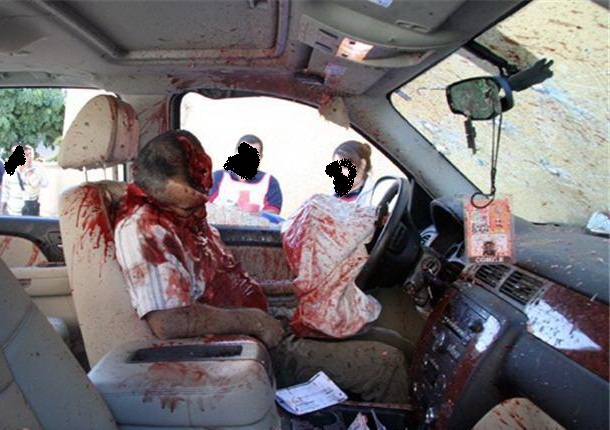
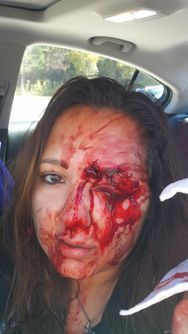
Below are 2 photos of injuries sustained from exploding TAKATA AIRBAGS:
NHTSA launches pilot program to alert owners of uncompleted auto recalls
David Shepardson
Reuters
WASHINGTON -- The National Highway Traffic Safety Administration said Friday it is funding a pilot program that will notify drivers in the state of Maryland if there are open, uncompleted recalls at the time that they register their vehicles.
The government says only about 70 percent of auto safety recalls have led to repairs or resolution of the problematic issues.
Automakers, who have recalled record numbers of vehicles in recent years, have struggled to convince millions of owners of vehicles with potentially faulty Takata airbags to get the necessary repair work done.
The number of U.S. vehicle recall campaigns hit a record high in 2016 for a third consecutive year, with 927 separate recalls affecting 53.2 million vehicles.
That total was bloated by recalls of Takata airbag inflators, which can rupture and send deadly metal fragments flying, and are already linked to 18 deaths and more than 180 injuries worldwide. Those recalls will eventually cover about 125 million inflators, representing the largest single auto safety recall ever for a single issue.
As of June, more than 65 percent of 46.2 million previously recalled Takata inflators in the United States had not been repaired.
Congress gave NHTSA the authority to provide grant funding for up to six states that agreed to pilot programs to notify consumers of open recalls on their vehicles at the time of registration, but Maryland was the only state to apply.
"This first-in-the-nation grant will serve as an example to the rest of the country as we continue to work across government to reach consumers in new and creative ways with potentially life-saving information about their vehicles," Transportation Secretary Elaine Chao said in a statement.
Recalls jumped in 2014 after Congress held a series of hearings about major auto safety issues involving General Motors ignition switches and Takata airbags. In 2014, a record 63.95 million vehicles were recalled in the United States -- more than twice the previous record set in 2004.
Some automakers, such as Honda Motor Co., whose vehicles account for 17 of the 18 reported Takata-related deaths to date, are taking additional steps to locate vehicles with the potentially dangerous inflators.
Raising questions about the future of the embattled parts supplier, Honda Motor Co said it will no longer use front air bag inflators made by Japan's Takata Corp. Takata counts Honda as its biggest air bag customer. USA TODAY
U.S. automotive safety regulators on Tuesday said Japanese auto supplier Takata has agreed to accept penalties for failures involving exploding air bags that have killed at least eight people and injured at least 98.
CLOSE
Honda (HMC) is dumping longtime supplier Takata over its
deadly airbags. None of Honda's new car models under
development will use the company's airbag inflators. Newslook
The National Highway Traffic Safety Administration will fine Takata at least $70 million and could increase that penalty up to $200 million if the supplier does not adequately comply with a plan to accelerate recalls of defective air bags and eliminate a chemical that may have caused the incidents. It's the largest civil penalty in the agency's history.
In another blow, Honda said Takata had "misrepresented and manipulated test data" on air bag inflators and said it would not use the Japanese auto supplier's air bags in any future products. All of the known deaths so far attributable to Takata air bags occurred in Honda's vehicles.
Takata acknowledged "that it was aware of a defect but failed to issue a timely recall," NHTSA said.
Consequently, the Department of Transportation is leveraging never-before-used authority to force Takata and major automakers to speed their efforts to fix 19 million vehicles fitted with potentially defective air bags. NHTSA is an agency within the department.
NHTSA will also appoint a monitor to oversee Takata's air bag recall, which must be completed about two years earlier than previously planned. A date, however, was not specified.
"American drivers should not have to worry that a device designed to save their life might actually take it," Transportation Secretary Anthony Foxx told reporters at a press conference.
Foxx said Takata had fired employees as a result of the federal investigation, but he said he did not know how many. He also said Takata had moved from "kicking and screaming" over the suggestion that its air bags were defective to an admission of fault.
Takata said in a statement that it's "committed to being part of the solution" through further investigation of the matter, accelerated recalls and improved safety procedures.
"We deeply regret the circumstances that led to this," Takata CEO Shigehisa Takada said. "This settlement is an important step forward for Takata that will enable us to focus on rebuilding the trust of automakers, regulators and the driving public."
The root cause of the exploding air bags remains a mystery, although federal investigators suspect that it may be related to ammonium nitrate propellant. As part of the consent agreement, Takata must phase out the use of ammonium nitrate propellant unless it can prove that it's not related to the exploding air bags.
In dumping Takata as an air-bag supplier, Honda said it had provided details and documents on the Takata data to NHTSA during the agency's investigation but had not publicly disclosed the information until Tuesday.
"Honda expects its suppliers to act with integrity at all times and we are deeply troubled by this apparent behavior by one of our suppliers," the company said.
NHTSA also left open the possibility that it will require Takata to recall all the air bags it has ever produced with ammonium nitrate.
Regulators have urged consumers to get their vehicles repaired for free as soon as possible.
Vehicles that have been housed in hot, humid climates for at least five years are most at risk, suggesting that climate is a contributing factor. NHTSA is forcing the auto companies to give those vehicles priority in the recall process.
Foxx said he suspects that "millions more" vehicles may be recalled once NHTSA finishes its probe into the air bags.
NHTSA also expanded its investigation in October to include a side air bag inflator that has ruptured in accidents involving General Motors and Volkswagen vehicles.
The agency had already ordered a recall of 19 million vehicles — of which 14 million are from BMW, Fiat Chrysler, Ford, Honda and Mazda. The rest are from General Motors, Mitsubishi, Nissan, Subaru, Toyota, and Daimler.
About 6 million of those vehicles are considered by NHTSA to be of the highest priority because of their location and age.
Production of replacement air bag inflators and harnesses used to mount the devices is proceeding at a rate of about 2.8 million units per month. Other air bag manufacturers are making about 70% of the parts to aid Takata in speeding the repairs.
NHTSA's action against Takata drew a swift reaction from U.S. Sen. Richard Blumenthal, D-Conn., and U.S. Sen. Edward Markey, D-Mass., who have both criticized the auto industry for safety failures.
"Meager fines do nothing more than change the costs of doing business and provide no meaningful deterrence for continuing reprehensible and irresponsible behavior that costs countless preventable injuries and lives," they said in a joint statement. "Today's action provides further evidence that the cap on civil penalties levied by NHTSA must be eliminated by Congress, and we must also reform the criminal penalties associated with concealing life-saving information about defects from the public."
Just a reminder: It's important that this RECALL be addressed.
Your vehicle MAY be involved in a safety recall and MAY create a safety risk for you or your passengers. If left unrepaired, a potential safety defect could lead to injury or even death. Safety defects must be repaired by a dealer at no cost to you.
Why am I getting this email?
You are receiving this message because you requested to be notified by the National Highway Traffic Safety Administration (NHTSA) if there is a safety recall that may affect your vehicle.
The following may apply to one or more of your vehicles if your vehicle is listed below. Click on the NHTSA Campaign ID number below to read more about the safety issue and the reason for the recall.
To find out if your specific vehicle is included in the recall, use our VIN Look-up Tool.
What is a recall?
When a manufacturer or the National Highway Traffic Safety Administration (NHTSA) determines that a car or item of motor vehicle equipment creates an unreasonable risk to safety or fails to meet minimum safety standards, the manufacturer is required to fix that car or equipment at no cost to the consumer. That can be done by repairing it, replacing it, offering a refund (for equipment) or, in rare cases, repurchasing the car.
What should I do if my vehicle is included in this recall? If your vehicle is included in this recall, it is very important that you get it fixed as soon as possible given the potential danger to you and your passengers if it is not addressed. You should receive a separate letter in the mail from the vehicle manufacturer, notifying you of the recall and explaining when the remedy will be available, whom to contact to repair your vehicle or equipment, and to remind you that the repair will be done at no charge to you. If you believe your vehicle is included in the recall, but you do not receive a letter in the mail from the vehicle manufacturer, please call NHTSA's Vehicle Safety Hotline at 1-888-327-4236, or contact your vehicle manufacturer or dealership.
Thank you for your attention to this important safety matter and for your commitment to helping save lives on America's roadways.
In the event of a crash necessitating deployment of the passenger's frontal air bag, the inflator could rupture with metal fragments striking the vehicle occupants potentially resulting in serious injury or death.
The National Highway Traffic Safety Administration is investigating reports of braking issues in 2007-09 Ford Fusions and Mercury Milans believed to have caused three crashes.
NHTSA received 141 reports of “sudden, unexpected increases in stopping distance” believed to have been caused by problems in the anti-lock braking system hydraulic control unit. In some of the reports, the brake pedal would go “soft” after the ABS engaged while braking on slippery, rough or uneven surfaces.
Drivers reported the brake pedal “going to the floor” in some instances, and the brakes required increased pressure by the driver to stop the car.
“In some cases the driver is unable to stop within their desired stopping distance,” according to the NHTSA investigation, which was opened Dec. 20. “Complainants have also reported going past the expected stopping points for stop signs or red lights, some have reported being out into the flow of traffic before being able to bring the vehicle to a stop.”
Ford Motor Co. in a statement Tuesday said, “We’ll cooperate with the agency on its investigation, as we always do.”
NHTSA believes the anti-lock braking system experiences an internal malfunction causing “an inability to maintain required baking pressure.”
Reports say the brakes correct themselves after some time. Some reports indicate a recurring problem, while others indicate the replacement of the ABS hydraulic control unit fixes the problem.
The NHTSA Office of Defects Investigation has associated three crashes with the brake problem. The investigation was opened “to assess the scope, frequency, and safety-related consequence of the alleged defect.”
The Fusion and Milan were recalled in June for defective Takata air bag inflators that can explode and throw shrapnel. Nearly 70 million air bags with defective inflators have been recalled; they were installed in vehicles from 19 manufacturers.
The exploding TAKATA airbag scandal highlights the failure of the auto industry and NHTSA to protect consumers.
PREVIOUS
Moulton: Democrats need to reflect on message, messengers
Congressman Seth Moulton on Monday called for "serious intro…
NEXT UP
Legislature urged to fight budget cuts
BOSTON — Advocates for the homeless, substance abuse treatme…
Consumer groups criticize deal on auto recalls
By Christian M. Wade Statehouse Reporter
BOSTON — Consumer advocates are blasting an agreement between regulators and used-car dealerships over auto recall disclosures, saying the deal endangers public safety.
Last week the Federal Trade Commission reached agreements with CarMax, the largest U.S. used-car dealer with more than 140 locations, including one in Danvers; Atlanta-based Asbury Automotive Group Inc.; and West-Herr Automotive Group in New York.
Under proposed consent orders, the dealers cannot claim that used vehicles are safe unless recall repairs have been made or open recalls are disclosed to buyers. They also must notify customers that cars bought as far back as 2013 may be subject to recalls.
The settlement did not impose fines or sanctions on the dealers.
The commission also reached agreements in similar cases with General Motors Co. and two other retailers, Jim Koons Management in the mid-Atlantic and Lithia Motors Inc. in Oregon.
In a statement, the Federal Trade Commission said some in the industry “touted how rigorously they inspect their used cars yet failed to adequately disclose that some of the cars were subject to un-repaired safety recalls.”
Consumer advocates say the deal is a giveaway to the used-car industry because it allows companies to disclose that cars “may” be subject to recalls without actually repairing them.
“The bottom-line here is that the result will be more consumers buying unsafe cars, putting the lives of not just themselves but everyone who shares the roadways in danger,” said Deirdre Cummings, legislative director at Massachusetts Public Interest Research Group.
“Consumers rightly have the expectation that when shopping at any car dealership they will be sold a safe car, and at the very least, they certainly would not expect that any car for sale would still be under a safety recall,” she said.
Flawed system
But some in the used-car business say the recall system is flawed, and rules such as last week’s consent order unfairly keep them from selling cars that are safe to drive.
Not all recalls issued by manufacturers and the government are safety-related, said Robert O’Koniewski, executive vice president of the Massachusetts State Automobile Dealers Association.
“It could be a page in the owner’s manual that needs to be changed or something wrong with the cup holders in a vehicle console,” he said.
Federal law prohibits auto dealers from selling new cars that are under recall, he said, but there are no such requirements for used vehicles.
In Massachusetts, the state’s “lemon law” requires dealers to disclose recalls on used cars — as well as any other information that could affect the sale, such as a dent that needs repairing — but it doesn’t require them to fix the problems.
National consumer groups say they plan to sue the government to block last week’s agreement. Rosemary Shahan, president of Consumers for Auto Reliability and Safety, a Sacramento, California-based advocacy group, called the deal “tragic” and “reckless.”
U.S. Sen. Ed Markey, who with other lawmakers has pushed for stricter limits on the industry, said it “makes it easier for dangerous cars to remain on the road.”
“Instead of ensuring safe cars for consumers, the FTC is ensuring safe harbor for used car dealers who provide false and deceptive assurances,” Markey said in a statement.
CarMax COO Cliff Wood said his company is an industry leader in transparency over recalls but will alter its sales and advertising language to comply with the agreement and keep consumers informed.
“We share vehicle-specific, open-recall information in store and online to ensure our customers know about open recalls prior to purchase,” Wood said in a statement. “We will continue to make enhancements to our comprehensive recall disclosure program.”
CarMax said all of its used cars “meet or exceed state safety inspection requirements,” but noted that recalls must be “repaired at a manufacturer-authorized facility.”
“The recall system is based on the manufacturer’s relationship with its dealers and registered vehicle owners, and not with independent used auto retailers,” the company said. “Among other things, this means that manufacturers have not authorized CarMax to complete recall repairs.”
Last year, MassPIRG and other groups released a report claiming that more than 17 percent of vehicles sold at CarMax’s North Attleboro dealership were subject to a federal safety recall that had not been repaired. Several vehicles had faulty transmissions that could allow the vehicle to roll away and injure people exiting the car or bystanders, according to MassPIRG.
AG intervention?
Advocates are looking to Attorney General Maura Healey to intervene by enforcing a state law that prohibits dealers from selling unsafe used cars and using deceptive sales practices.
Emily Snyder, a spokeswoman for Healey, said the office would be concerned if retailers fail to make repairs or alert customers about known recalls or other safety-related issues.
Sean Kane, president of Safety Research and Strategies Inc. in Rehoboth, said increasing numbers of recalls and deceptive sales practices confuse consumers.
Last week’s ruling, he said, “will only add” to the confusion.
“There’s a staggering number of recalls out there,” he said, noting estimates that suggest 1 in 5 vehicles are subject to a recall.
One major recall, for example, involves Takata-made airbags, some of which have exploded when deployed.
A November 2014 recall of the driver- and passenger-side airbags affects 14 automakers, 22 brands and more than 100 million vehicles worldwide, in what regulators say is the largest, most complex auto safety recall in U.S. history.
O’Koniewski said auto manufacturers are not able to keep up with the demand for parts to make repairs — including the Takata airbags.
“The shortage of parts is a huge problem,” he said. “Dealers are being forced to sit on new vehicles until the parts become available.”
The National Highway Traffic Safety Administration, which oversees vehicle recalls, offers car-buyers and owners a search tool to check for recalls at www.safercar.gov. Most dealerships can also provide a CarFax report on used vehicles that will show if it’s subject to a recall.
Christian M. Wade covers the Massachusetts Statehouse for The Salem News and its sister newspapers and websites. Email him atcwade@cnhi.com.
Toyota has announced an expansion of recalls related to Takata's fatally flawed airbags. According to the automaker, the 2008 Toyota Corolla, 2008 Toyota Matrix (aka the Toyota Corolla Matrix), and the 2008-2010 Lexus SC 430 will be added to the recall roster.
As with all Takata recalls, this one is designed to replace airbag inflators equipped with ammonium nitrate. Ammonium nitrate is a notoriously unstable compound, and studies have shown that, in the presence of heat and moisture, airbags that use ammonium nitrate can become deadly weapons. To date, dozens of those devices have exploded upon deployment, pelting vehicle occupants with shrapnel and injuring more than 100. At least ten deaths have been linked to Takata's airbags.
Today's recall is meant to replace passenger-side airbag inflators. (As you might recall, the Takata recall has been frustratingly complicated, divvied up geographically and by separate recalls for driver- and passenger-side devices. Takata's unwillingness to cooperate with investigators hasn't helped matters.)
The recall affects roughly 198,000 vehicles registered in the U.S. Toyota says that owners will receive recall notices by mail, asking them to visit their local dealers, who will replace the airbag inflator or the airbag assembly, free of charge.
Meanwhile, in Washington, D.C., Senator Bill Nelson (D-FL) is asking the National Highway Traffic Safety Administration to recall all vehicles with Takata airbags that rely on ammonium nitrate. If NHTSA were to agree to the Senator's request, it could add up to 90 million vehicles to the recall roster.
However, NHTSA administrator Mark Rosekind seems unlikely to go along with that idea. In a letter to Nelson, he notes that such a massive expansion of the Takata recall would complicate matters and slow down the recall process, which is already hampered by a shortage of replacement parts.
The Senator may eventually get his wish, though. Takata has agreed to recall all devices equipped with ammonium nitrate in 2019 if the company can't prove that they're safe.
NHTSA dismisses calls for widespread Takata recall
By Justin King
Thursday, Mar 3rd, 2016
The National Highway Traffic Safety Administration has dismissed calls for a much wider ruling on Takata's airbag inflators.
Some legislators have asked the NHTSA to demand a broader recall of every Takata inflator that uses ammonium-nitrate propellant. Safety advocates have claimed Takata covered up internal tests showing which inflators are prone to failure, while poor record keeping has further contributed to confusion.
Exemplifying the concerns, shrapnel injuries were blamed for a Ford Ranger driver's death in a recent accident. The passenger-side airbag had already been recalled, however the driver-side inflator was not deemed defective until after it had been associated with a fatality.
"A blanket recall of all inflaters would be easier to explain, but it would not serve safety and could run the risk of exceeding NHTSA's statutory authority," agency head Mark Rosekind wrote in a letter to a concerned senator, as quoted by The New York Times.
Regulators have pushed for the highest-risk vehicles to be repaired first, including older models and those that have been operated in regions of high humidity. Both age and moisture have been cited as primary factors in propellant degradation and consequent explosions.
Despite Rosekind's dismissive comments of a total recall in the near term, a consent order with Takata requires the company to prove that its ammonium-nitrate inflators are safe. The remaining population, including tens of millions of inflators, could be deemed defective if the company cannot verify their safety by 2018.
Toyota's KILLER vehicles are STILL on the road
-
*Update 11/21/2019 - This 11/3/2019 article exposes the scandal of thug
goon Toyota's many dangerous **vehicles that are still on the road.** If
the link d...
Highlights of an Injustice…
-
Please note that as of July 1, 2017, the JoanTreppa.Wordpress.com blog has
been discontinued and in its place is my new website JoanTreppa.com. I have
tran...