Showing posts with label Toyota blaming drivers. Show all posts

Saturday, October 17, 2015

NECN, Jackie Bruno, FULL DISCLOSURE and Slanted Media Cover up!


Former Miss Massachusetts USA & runner up, Jackie Bruno....? 

Her parents are principals in ROUTE 44 TOYOTA

Now Jackie! How 'bout FULL DISCLOSURE? 

It is TOYOTA'S PROPAGANDA to BLAME THE DRIVER....much easier when it's an elderly driver! 

Elderly Woman Slams Car 

Into Greater Boston Gym

Elderly Woman Crashes Into a Mass. Gym (Published Thursday, Oct. 8, 2015
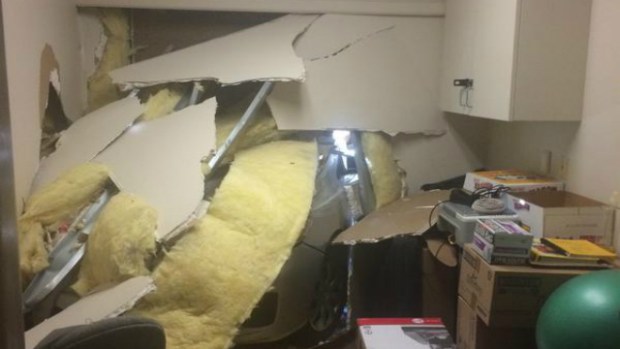
A car slammed into a Boston Sports Clubs location in Newton, Massachusetts, on Thursday afternoon.
The accident was reported around 2 p.m. at the gym at 135 Wells Ave. The car went right through an exterior wall and into an unoccupied office/storage area.

A view of the crash from inside Boston Sports Clubs.
Photo credit: Courtesy
"I just heard a big bang. And the desk was moving over to one of the rooms, and I saw the wall crashing a little bit in," said Cidalia Aguiar, a physical therapist at the health club. "I'm glad no one was in hte room."
No one was injured, and a passenger in the car actually went inside and started working out as crews worked to remove the vehicle.
The driver was an 82-year-old woman. Police said she hit the gas pedal instead of the brake while attempting to park in a handicap spot.

http://www.necn.com/news/new-england/Car-Slams-Into-Boston-Area-Health-Club-331337292.html


2000 - 2015 TOYOTA COROLLA Vehicle Speed Control Problems 
http://www.arfc.org/complaints/2015/toyota/corolla/vehicle_speed_control/problem.aspx 
http://www.arfc.org/complaints/2014/toyota/corolla/vehicle_speed_control/problem.aspx
http://www.arfc.org/complaints/2013/toyota/corolla/vehicle_speed_control/problem.aspx
http://www.arfc.org/complaints/2012/toyota/corolla/vehicle_speed_control/problem.aspx
http://www.arfc.org/complaints/2011/toyota/corolla/vehicle_speed_control/problem.aspx
http://www.arfc.org/complaints/2010/toyota/corolla/vehicle_speed_control/problem.aspx
http://www.arfc.org/complaints/2009/toyota/corolla/vehicle_speed_control/problem.aspx
http://www.arfc.org/complaints/2008/toyota/corolla/vehicle_speed_control/problem.aspx
http://www.arfc.org/complaints/2007/toyota/corolla/vehicle_speed_control/problem.aspx
http://www.arfc.org/complaints/2006/toyota/corolla/vehicle_speed_control/problem.aspx
http://www.arfc.org/complaints/2005/toyota/corolla/vehicle_speed_control/problem.aspx
http://www.arfc.org/complaints/2004/toyota/corolla/vehicle_speed_control/problem.aspx
http://www.arfc.org/complaints/2003/toyota/corolla/vehicle_speed_control/problem.aspx
http://www.arfc.org/complaints/2002/toyota/corolla/vehicle_speed_control/problem.aspx
http://www.arfc.org/complaints/2001/toyota/corolla/vehicle_speed_control/problem.aspx
http://www.arfc.org/complaints/2000/toyota/corolla/vehicle_speed_control/problem.aspx


JUST MY THOUGHTS....AT THE MOMENT!


Sunday, September 27, 2015

Toyota Admits Software Misread Crash Data; Bug Subsequently Fixed


Toyota Admits Software Misread Crash Data; Bug Subsequently Fixed


"Change of Speed" entry in Event Data Recorder was accessed incorrectly.


has acknowledged and subsequently fixed a bug in laptop software used to access its crash information. In a key case reported in August, the software error caused a misreading of vehicle speed. In accessing a crashed EDR, its "Delta-V" (change in vehicle speed at the time of the accident) was read at more than 170 mph, a speed far beyond the truck's capability.
According to Toyota's product development and research chief, Takeshi Uchiyamada, the problem had not been with the EDR itself, but rather with laptop software used to access EDR data. He said the 150 EDR access devices currently in use in the U.S. are now bug-free.
All this is relevant to investigations undertaking by the government's National Highway Traffic Safety Administration. Based on its examination of 58 Toyota EDRs, NHTSA reported no incidents along the lines of the company's earlier problems with floor mat interference or faulty accelerator pedal damping. In more than half the recorders examined, there was no indication that drivers applied brakes, suggesting error rather than vehicle "unintended acceleration."

(comment):
Maret Jaks - m.k. jaks
Given that it has now been made clear that Toyota was lying about its floor pads and that
there was a software glitch that caused so many deaths (they've admitted they lied twice
and the US has fined them $1.2 Billion), this article should be updated with a comment
regarding this fact?
http://www.glitchwatch.com/
http://www.roadandtrack.com/new-cars/car-technology/news/a16540/toyota-admits-software-misread-crash-data-bug-subsequently-fixed/


Saturday, January 31, 2015

TOYOTA's Expert LIES UNSUCCESSFULLY, Paid $1.4 MILLION!


Doesn't this beat all?


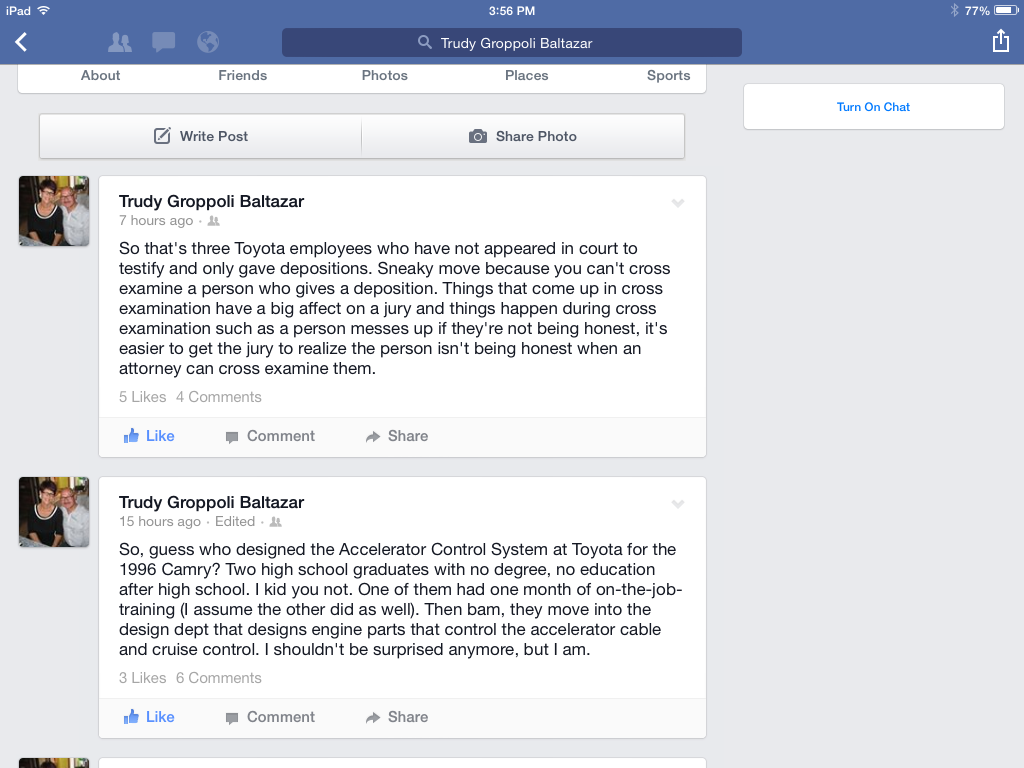
Thanks go to Trudy Baltazar for documenting TOYOTA'S ANTICS!


Bob Hilliard Startled Courtroom in 1996 Toyota Camry Liability Lawsuit


http://trulinespublishing.com/2015/01/31/bob-hilliard-startles-courtroom-1996-toyota-camry-liability-lawsuit/


Let's not forget that TOYOTA BLAMED THE DRIVER in Oklahoma [Bookout & Schwarz] and couldn't explain SKID MARKS indicating the DRIVER tried to slow the RUNAWAY TOYOTA!


When the jury didn't believe TOYOTA'S LIES, TOYOTA rushed to settle with a confidentiality agreement. We'll never know what lives are worth to TOYOTA!


Wednesday, November 12, 2014

Complaints on Toyota went for naught


Complaints on Toyota went for naught

Mass. case casts light on US investigations


By Erin Ailworth
Globe Staff


As he drove home to Braintree from Florida in 2003, Peter Boddaert’s black Lexus LS400 suddenly raced forward and rear-ended a van as he was switching lanes in Virginia. It was the third time his car had accelerated without warning, long before major safety concerns with Toyota-made cars had surfaced.
“I pressed like hell on the brake, but was unable to completely stop the car,’’ Boddaert wrote in a letter to his insurance agency.

He took the luxury sedan to his dealer, and, again, no problem could be found. Frustrated and scared, Boddaert got rid of the car; but at the urging of his family, he filed a petition with the National Highway Traffic Safety Administration to request it investigate such incidents with the Lexus, made by Toyota Motor Corp.

The Boddaert case triggered the first of eight federal investigations, from 2003 to 2009, into claims of unintended acceleration involving cars or trucks made by Toyota. Federal officials rejected Boddaert’s claims, partly based on a 1989 study that blamed driver error for most incidents of unwanted acceleration. Boddaert died in April at age 88.


The government’s handling of Boddaert’s case sheds light on how investigators may have underestimated a serious problem, repeatedly dismissing claims from drivers worried that something was wrong with their vehicles, even in the face of numerous acceleration complaints.
Toyota recently recalled some 8.5 million vehicles to address issues related to unintended acceleration, offering fixes to floor mats and gas pedals. But Boddaert’s car, the 1999 Lexus LS400, was not on the list, raising the question of whether Toyota has adequately addressed concerns about unintended acceleration.
 
Over the past decade, at least 2,262 Toyota and Lexus drivers nationwide - including about 80 in Massachusetts - have reported that their cars have sped up on their own, according to Safety Research & Strategies Inc. in Rehoboth. Roughly half of those complaints involved Toyota models that have not been recalled.
 
“I’d wager an awful lot of money that we’re going to see a lot of recalls on sudden unintended acceleration in Toyota vehicles over the next few years,’’ said Safety Research founder Sean Kane, who testified during congressional hearings on Toyota this week. Safety Research, which supplies research on safety matters to attorneys and plaintiffs in civil lawsuits, compiled the acceleration data using consumer complaints, media accounts, court documents, and other sources.
 
Kane told the Globe that he believes the total number of recalled Toyota vehicles could climb to 15 million, based on cases of unintended acceleration.
 
Officials at the National Highway Traffic Safety Administration declined several requests for interviews about its handling of the Boddaert case; Toyota also did not respond to requests for comment. But a December deposition of a Toyota employee suggested the carmaker and federal officials worked together to limit the investigation of sudden acceleration problems.
 
“We discussed the scope,’’ said Christopher Santucci, adding that Toyota and the agency agreed to focus on a narrow definition of unintended acceleration for the investigation.
 
“I think it worked out well for both the agency and Toyota,’’ he said.
Something wrong
 
Boddaert’s family said he experienced his first problem with unintended acceleration in 2002 - less than a year after purchasing the car from Lexus of Norwood. He bought the luxury sedan on a whim, replacing a more modest Toyota Camry.
“He took the Camry for an oil change and came back with a Lexus,’’ recalled son Jack Boddaert.

“My dad would probably tell you it was the most comfortable car he’d ever driven.’’
 
The Globe examined Peter Boddaert’s case based on federal documents, accident reports, and interviews with his family.

Boddaert was trying to back out of the driveway at his winter home in Florida when he experienced his first incident of unintended acceleration. The sedan “shot backwards,’’ his son recalled. Boddaert took the car to his Florida dealer, and, later, to Lexus of Norwood, but neither could find anything wrong. A spokesman for Herb Chambers Group, which owns the Norwood dealership, said mechanics tested the car’s systems and drove it both on city roads and the highway, but couldn’t duplicate the problem.
 
“My feet were pushing desperately on the brake,’’ Boddaert wrote a few days after the incident, in a letter to Lexus. “I am sure you will agree that there is something seriously wrong that Lexus needs to be made aware of and cure. Even the most basic vehicle should not suffer from a problem of this dangerous nature.’’

Later, while Boddaert was driving on the highway, the car again sped up suddenly, slowing only when he shifted into neutral, Jack Boddaert said. After the third incident - the one that resulted in the fender-bender in Virginia - Boddaert petitioned the NHTSA for an investigation. He also gave up the car.
 
At the time, Jack Boddaert said, the family feared that someone could be injured or killed if authorities did not take the problem seriously. His father was 83 at the time, and “it would have been very difficult to convince people that there was a problem with the car, and not with him.’’

That fear prompted the family to insist that Toyota send an engineer to inspect the vehicle. It was a lesson in frustration.
 
“They were very, very difficult to deal with,’’ Jack Boddaert said. “I made calls, and my mother made calls. It started off as, ‘Well, we’ve never heard of that problem’ to ‘Well, we’ve had it checked. There’s nothing wrong with the car.’ ’’


On Tuesday, during congressional hearings about Toyota’s recent problems, Representative Edward J. Markey, a Malden Democrat, questioned US Transportation Secretary Ray LaHood about the Boddaert case.
 
Markey noted that federal investigators were not informed by Toyota that in 2000, three years before Boddaert’s petition, Toyota recalled a Lexus model in the United Kingdom for a floor mat problem “identical’’ to the one behind recent recalls in the United States.
 
“Do you think the department might have reached a different conclusion had it known about the 2000 Lexus UK recall involving the floor mats entrapping accelerator pedals?’’ Markey asked.
 
LaHood replied, “I would assume that we would have, but that’s a guess.’’
Complaint dismissed
 
In his 2003 petition, Boddaert noted that the highway safety agency had received 271 Lexus-related complaints, with 36 citing a problem with “vehicle speed control.’’ Boddaert wrote that the number of complaints represented a “significant’’ safety concern.
Investigators considered cases of unintended acceleration in several other car brands, and referred to their own 1989 study on unintended acceleration, conducted by the Volpe National Transportation Systems Center in Cambridge.
 
E. Donald Sussman, a coauthor of the 1989 study, recalled that at the time it was conducted, federal officials posed one overarching question: “Was it real?’’
 
Sussman’s team at the Volpe Center tested 10 mid-1980s cars with the highest number of acceleration reports, including two model years of the Audi 5000 sedan, a Chevrolet Camaro, and a Toyota Cressida. They concluded that design flaws caused drivers to hit the wrong pedal, or step on both the gas and the brake at the same time.
 
Two months after opening the Boddaert investigation, federal officials dismissed the case, writing that a comparison of sudden acceleration complaints in other luxury car brands found “no evidence that Lexus vehicles are experiencing speed control-related problems more frequently than their peers.’’ The agency also cited the 1989 sudden acceleration study, which said, “The inescapable conclusion is that these definitely involve the driver inadvertently pressing the accelerator instead of, or in addition to, the brake pedal.’’


BLAME THE DRIVER! AN ALL TOO COMMON TACTIC!

 
Sussman, who worked at the Volpe Center for 34 years, said his study was “well received’’ at the time, but “the Toyota problem [now] is different.’’

Steven Spear, a senior lecturer at MIT who has written about Toyota, said electronics “might play a big role in this thing.’’ Spear and other industry insiders said cars now have electronic controls that are much more sophisticated than in the 1980s, and those systems could be a source of the problem, a claim Toyota has repeatedly denied.
‘Electronic maze’
 
Like others who have struggled with acceleration issues in Toyotas, Jack Boddaert questioned whether the agency dismissed his father’s case partly because it was overwhelmed by the complexity of modern cars.
“I wonder whether their funding and staff expertise are in line with our expectations,’’ Jack Boddaert wrote in a follow-up e-mail to the Globe, “especially now, when the car has become such an electronic maze.’’
 
After the case was dismissed, Jack Boddaert tried to persuade his father to get a lawyer and sue, but the elder Boddaert was tired of the stress and wanted to leave the incidents behind him.

Now, Jack Boddaert is ready to pick up where his father left off, saying he would be “happy’’ to take on Toyota again, and may join a class-action suit, as other Toyota owners have done.
 
“I would say to Toyota, if you had taken this thing seriously five or six years ago and really done something about it,’’ he said, “you would have avoided the huge catastrophe you have now.’’


http://www.boston.com/business/articles/2010/02/25/a_lexus_owners_frustrating_journey_through_complaint_process/?page=full


Friday, June 20, 2014

TOYOTA's Carefully Worded, OUTDATED Propaganda Defies Reality and "A NEAR DEATH EXPERIENCE" ...


Rhonda Smith shared her "NEAR DEATH EXPERIENCE IN AN OUT-OF-CONTROL TOYOTA" with Congress: 


Can you listen to Rhonda Smith's testimony and continue to believe TOYOTA'S CLAIMS


Below are videos from Beasley Allen, the law firm that represented the families on the TOYOTA SUDDEN UNINTENDED ACCELERATION case in Oklahoma - that's the jury trial in which Michael Barr explained TOYOTA'S SPAGHETTI SOFTWARE and TOYOTA LOST! 


TOYOTA RUSHED TO SETTLE as the jury deliberated punitive damages! 

It should surprise no one who has followed TOYOTA'S PLAYBOOK that TOYOTA included a confidentiality agreement - A GAG ORDER! 


"TOYOTA...misled the public....malfunction has caused injuries and death.....TOYOTA lied to the government...reckless disregard.....wire fraud...."


TOYOTA'S PROPAGANDISTS have dredged up this video...come on folks! 

This in the wake of several recent OUT-OF-CONTROL TOYOTA accidents that   injured and killed folks? 

Yup! NEW TOYOTAS! CLOSED TRACK! 


And then when a comment is posted disagreeing with the TOYOTA PROPAGANDA....you guessed it! 

It gets deleted! 


THIS IS THE COMMENT BY CHARLENE BLAKE THAT WAS BLOCKED: 


Mike Michels, it seems that you are suffering from extreme DENIAL about some major problems in Toyota and Lexus vehicles. Either that or you are grossly misleading the public once again. Which is it? 

Back in the middle of the Toyota and Lexus engine oil sludge debacle, you and John Hanson repeated like a parrot that Toyota had "never seen a single case of engine oil sludge in a properly-maintained Toyota." Hmmmm...that's not even funny because thousands of Toyota and Lexus owners informed Toyota that they HAD maintained their vehicles as per manufacturer's recommendation and STILL ended up with failed engines which needed to be replaced!

Further, you and your company finally buckled under public pressure and came out with a voluntary engine oil sludge program which owners report you essentially did not honor behind the scene. A successful Toyota and Lexus owner class action lawsuit resulted but you still did not honor your promises, according to vocal Toyota owners. Just like in the GM case, all we hear from you and your company is empty rhetoric and promises you do not keep! 

The problem is, Mr. Michels, you and your company did not want to SEE the engine oil change receipts of these customers because then you WOULD BE AWARE of the problem. You, your company, and your reputation management have been overpowering vehicle owner factual statements it seems. This same behavior, it seems, is current in the case of alleged ELECTRONIC sudden unintended acceleration in Toyota and Lexus vehicles. Owners keep informing you exactly what is taking place in these runaway vehicles. Yet you and your company keep misleading the public that no such problem exists. You once again blame the owners for the horrific circumstances that they find themselves in either in parking lots or on the highways. Speeding out of control with no way to stop a vehicle is no walk in the park, Mr. Michels! Perhaps you'd like to try it sometime to have some true empathy for these loyal Toyota and Lexus owners? 

OK, we understand why you can't come out and reveal the inherent sloppy design in your ETCS-i. It's all about economics and your bottom line. However, countless lives have been sacrificed as your company uses its customers as "test pilots" in vehicles which do not have the appropriate safety standards (aren't regulated, of course) to prevent such a deadly glitch from occurring. Further, your system's fail-safe (ability to stop the runaway) has been noted to be ineffective in cases where such a glitch occurs (see Michael Barr's findings Bookout vs. Toyota). It's all in the DESIGN of your ETCS-i embedded software. Nothing can be done until this system is built to strict safety standards, correct? 

In the meantime, no amount of rhetoric is going to stop these occurrences. Yes! You can continue to blame the Toyota and Lexus owners. You can malign their character by implying that they are lying when they say they are braking with all their might. You did it to Tanya Spotts who had soft tissue damage in her foot/ankle from frantically attempting to STOP her Lexus. What more can you ask these Toyota owners to do? You've already ask them to risk their lives because you and your company can't currently fix this problem. Russian roulette, isn't it?

Charlene Blake

suddenunintendedacceleration@gmail.com


Sunday, October 13, 2013

Noriko Uno: Last Minutes Filled With Terror As Toyota Camry Sped Out of Control


The Noriko Uno jury verdict hasn't changed my mind since MY LEMON TOYOTA failed to STOP.


Toyota U.S.A.  ignores COMPLAINTS! [as the NHTA web site clearly reveals.]


Toyota pronounces 'No Computer Error Message' ignoring that there is No Computer Error Code programmed.....and you can't get a list of those codes.....


Toyota U.S.A. is more willing to fund attorneys than in manufacturing SAFE TOYOTAS.


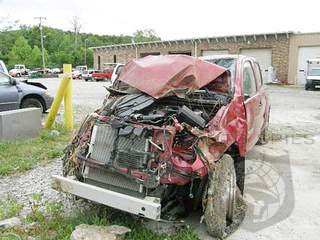
This is Noriko Uno's car.....


The California trial of Noriko Uno's defective Toyota took 2 months before being given to the jury to deliberate.
 
Because of the length of the trial, no media coverage is available and we can only rely of vague and disappointing accounts.

It is clear that there are several things that set this case apart:
 
1. Noriko Uno's vehicle was struck by another prior to her Toyota Camry's Sudden Unintended Acceleration
2. Witnesses indicated that they saw brake lights in Noriko Uno's attempt to stop her vehicle and she pulled the emergency brake   
2. Legal arguments were unigue

While no safety feature is mandated by federal regulation, no brake override, other manufacturers have included safety features that protect drivers and occupants.

It would seem that were Toyota not as arrogant, they would add such features to their vehicles to restore their integrity and reputation.

Below is a collage of articles and videos:


Jury Finds Toyota Not Liable in Death of California Driver


The case is the first of about 85 personal injury and wrongful death lawsuits brought against Toyota in California state court because of complaints related to sudden, unintended acceleration and the resulting wave of recalls in 2009 and 2010.

The 2006 Camry driven by the victim was not included in the recalls. 


The California jury’s decision is in line with Toyota’s winning verdicts in cases in New York and Philadelphia. Toyota is also on trial, or scheduled to stand trial, for death and personal injury lawsuits in Oklahoma City, Santa Ana, Calif., and Michigan.
 
The family of the victim, Noriko Uno, said that Ms. Uno tried to stop her 2006 Camry before crashing into a tree in Upland, Calif., but that a faulty accelerator and the lack of a brake-override system made the car speed out of control in the wrong direction on a one-way street.
 
The jury found that the Camry did not have a defect that caused the crash. It said that the driver of a vehicle that crashed into Ms. Uno’s car was at fault for the accident and should pay $10 million in damages to Ms. Uno’s husband and son.
 
It was the first so-called bellwether case in state courts, chosen by a judge to help predict the potential outcome of other lawsuits making similar claims.

Toyota Cleared, Other Driver Blamed Wrongful Death Lawsuit

Jury finds another driver, now 90 years old, who ran a stop sign and hit the woman should pay the family $10 million

Friday, Oct 11, 2013
Mardirossian argued Toyota made safety an option instead of a standard by not installing a mechanism to override the accelerator. He added the automaker also failed to warn customers what to do if an accelerator became stuck.
Toyota defended its vehicles, saying it had a state of the art braking system and argued an override component would not have prevented the crash. The company's lawyers said Uno likely mistook the gas pedal for the brake. [Toyota's ploy: Blame it on the driver! Witnesses reported seeing brake lights and the handbrake had been pulled in efforts to STOP Noriko Uno's Runaway TOYOTA as she sped to her death.] 


Toyota has blamed the driver, stuck accelerators or floor mats that trapped the gas pedal for the sudden unintended acceleration claims that led to the massive recall of its vehicles.
The verdict adds to the list of the automaker's court victories. In 2011, a federal jury in New York found the automaker wasn't responsible for a 2005 crash that the driver blamed on the floor mats or defects with the electronic throttle system.
The Toyota litigation has gone on parallel tracks in state and federal court, with both sides agreeing to settlements so far. A federal judge in Orange County is dealing with wrongful death and economic loss lawsuits that have been consolidated.
Federal lawsuits contend that Toyota's electronic throttle control system was defective and caused vehicles to surge suddenly. Plaintiffs' attorneys have deposed Toyota employees, reviewed software code and pored over thousands of documents.
Toyota has denied the allegation, and neither the National Highway Traffic Safety Administration nor NASA found evidence of electronic problems. [NASA examined computer codes according to reports, not cars or computers from cars.]
A trial in one of the lead cases is scheduled for early November.
The Uno case is the first so-called “bellwether” case in state courts, which is chosen by a judge to help predict the potential outcome of other lawsuits making similar claims.
Another sudden acceleration case began in Oklahoma this week. There are more than 80 similar cases filed in state courts.
Mardirossian said the evidence he presented at trial may help other pending cases against Toyota.
“We were able to demonstrate how their system can fail without a brake override system,” he said. “We found some chinks in Toyota's armor. I think the next case will be a winner.


Jury awards $10 million in Toyota death case but absolves automaker

Toyota faces its first federal case next month in Santa Ana, in a suit involving an elderly Georgia woman, Ida Starr St. John, whose Camry accelerated and crashed into a school.

The verdict in the Uno case may not be a strong indicator of the outcomes of future trials, because the attorneys in this case forwarded a somewhat unique legal theory.

Lawyers for other plaintiffs are set to argue that Toyotas contain electronic defects that can cause sudden acceleration. But Mardirossian, Uno's attorney, claimed that the car's lack of a brake override system was responsible for his client's death.

That fail-safe, designed to prevent a car from accelerating if the brake is depressed, was adopted by many auto manufacturers in the early 2000s, but Toyota didn't start using it until 2010.

Toyota's lawyers countered that the safety feature would not have saved Uno because, they alleged, she mistook the accelerator for the brake. What's more, they argued that brake override was not -- and still is not -- required under federal vehicle safety standards.

Belo, meanwhile, was driving a vehicle that smashed into Uno's Camry. The impact caused Uno's foot to become trapped on the accelerator pedal, leading the car to take off at high speed, ultimately crashing into a tree and a utility pole. The jury blamed that crash on Uno's death.

The sudden-acceleration issue first arose for Toyota after the August 2009 death of an off-duty California Highway Patrol officer and his family in a runaway Lexus ES outside San Diego.

The accident, which happened to occur the same day as Uno's fatal crash, drew national attention and led to a slew of huge and costly recalls, congressional hearings and more than $65 million in fines for federal safety code violations.

Numerous outside experts have claimed that the sudden-acceleration events could be caused by an electronic defect in Toyota vehicles, although no evidence has been presented that conclusively proves that theory.

Toyota, for its part, has vigorously denied those allegations and points to studies conducted by NASA and the National Academy of Sciences that did not find any such bug.

Toyota has been named in hundreds of lawsuits since the issue emerged. Before now, only one, in New York state, reached a jury.

Toyota has settled a number of cases, including a 2010 deal with the family of the CHP officer for $10 million, and a $1.6-billion deal, approved this year, in a class action case brought by thousands of Toyota owners claiming the sudden acceleration decreased the value of their vehicles.


Toyota also settled the first two major cases that had been selected by judges to go to trial this year, although the size of those settlements was not disclosed. GAG!

Another trial kicked off this week in Oklahoma state court. The plaintiff, Jean Bookout, claims that her 2005 Camry accelerated out of control -- injuring her and killing a passenger -- because of an electronic defect.

That trial is expected to last three weeks.


FROM: The Truth About Cars
Mardirossian said Uno was a cautious driver and neither floor mats nor driver error were to blame.

He said witnesses heard the Camry engine racing and saw brake lights going on and off. Pulling the handbrake had "zero effect," Mardirossian said.

"Imagine her strapped into her Toyota Camry driving 100 mph knowing the next move would be fatal," he said. "She saved many lives by veering off into that center median knowing that death was near."


'Souvenirs from NHTSA.'

Toyota settles wrongful death lawsuit


Toyota reached the agreement in the case brought by the family of Paul Van Alfen and Charlene Jones Lloyd, spokeswoman Celeste Migliore said. They were killed when their Toyota Camry slammed into a wall in Utah in 2010.
.....the Associated Press has conducted an investigation of its own, finding that Toyota has, for years, blocked access to event data recorder (EDR) information, and that the automaker has been inconsistent in revealing exactly what these devices do and do not record.

Toyota CA Sudden Acceleration Trial: Can you trust Toyota?


"Toyota decided to make safety an option instead of a standard on their vehicles,".....
Consumer Reports recently uncovered NHTSA's log books from 2008 that showed Toyota and Lexus vehicles accounted for over 40% of the complaints about uncontrolled acceleration in 2008 models. That's a significant percentage, especially considering that Toyota doesn't sell 40% of the cars on the market (it sells about 15% of all cars).

Frank Visconi:


Toyota: Shirking their responsibility...


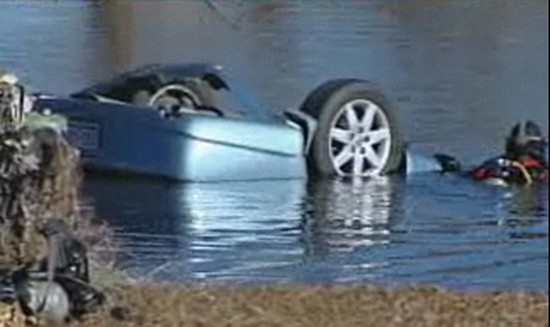
In the most tragic incident, on the day after Christmas, four people died in Southlake, Texas, a suburb of Dallas, when a 2008 Toyota sped off the road, through a fence and landed upside down in a pond. The car’s floor mats were found in the trunk of the car, where owners had been advised to put them as part of the recall.”
 
Toyota on Trial: Toyota KNOWS, keeps killing people it seems & HORSE MANURE
 
NEVER FORGET THESE WORDS --- TOYOTA KNEW AND ALLOWED PEOPLE TO DIE!

Toyota warned U.S. dealerships in 2002 that Camry owners complained of throttle surges and recommended adjusting the computer

"If you look at this document, it says electronics," attorney Clarence Ditlow said. "It says the fix is reprogrammed in the computer. It doesn't say anything about floor mats."

....repair bulletin proves the manufacturer misled the public about the causes of sudden acceleration.
FROM: http://middlebororeview.blogspot.com/2012/12/toyota-table-of-contents.html
.Toyota’s R&D chief Masatami Takimoto contradicted his own engineers, admitting in a March 2010 memo that every conceivable condition had not been anticipated: “When this Electronic Throttle Control System (ETCS) system was inspected, didn’t we fail to anticipate malfunctions such as an accelerator pedal itself remaining open?”FROM: Documents Contradict Toyota

FROM: Toyota: ...biggest and most deadly corporate cover up of all times...

Here are the latest developments in what I believe may be the biggest and most deadly corporate cover up of all time:......
The early Toyota investigation showed the problems and the luck associated with SUA investigations. NHTSA randomly two vehicles that repeatedly demonstrated SUA. NHTSA knew the problem was in the cruise control computer because if they moved the computer from the bad Toyota that had SUA to a good Toyota that did not have SUA, the good Toyota developed SUA. When NHTSA tested the vehicles at VRTC, it could not find a failure mode.


3 Ultimately, NHTSA gave the computers to Toyota to take to Japan and test. Although Toyota found a failure mode in the printed circuit board, details of the findings were kept confidential.
 
Toyota Whistleblower
[Noriko] Uno pulled her emergency brake before she died, proving she tried to regain control of the car
 
Other cases expected to go to trial in state courts this year include one in Oklahoma and another in Michigan. There are more than 80 similar cases filed in state courts.


Noriko Uno ..... and others....Innocent Deaths in Toyota Vehicles?

Documents Contradict Toyota
he dealer pleads: “… Engine revs stick at 6000 rpm without any reason. This issue occurs without any warning and at random cases. … (there were) two big car accidents in which the drivers miraculously escaped injuries. … the vehicle accelerated in an uncontrolled manner … more than 5 times … the Accelerator Sensor Assembly was replaced. … This issue could cost lives!!”

In another communication, a driver reported a Tundra zooming to 80 miles per hour, uncommanded, with ineffective brakes.

Toyota CA Sudden Acceleration Trial: Can you trust Toyota?


Owners Report Problems With Toyota Tacomas


Corporate arrogance.......


Former Toyota Lawyer: Automaker Hides Safety Problems

Uploaded on Feb 10, 2010
In an exclusive interview with ABC News, a former top lawyer for Toyota claims the automaker regularly hid evidence of safety defects from consumers and regulators, and fostered a culture of "hypocrisy and deceit."

"You have to understand that Toyota in Japan does not have any respect for our legal system," said Dimitrios Biller, who worked as managing counsel for Toyota's American operations from 2003 to 2007. "They did not have any respect for our laws."

Biller handled product liability suits while with the company. He claims that when Toyota received poor results in a vehicle rollover test, it ordered a new test in order to receive better results. According to Biller, the company also made a practice of concealing proof of safety problems, and did not disclose information it was obligated to produce


Are Toyota's Accelerators Out of Control?

Uploaded on Nov 4, 2009
Brian Ross Investigates the cause of hundreds of Toyota accidents. For more on this story go to http://abcnews.go.com/Blotter/Runaway...


Out of Control